Category: Links

  • The Passing of Stan Lee

    “By giving us superheroes that proved all too human, [Stan] Lee has assured himself a permanent place in pop culture.” — Beth Accomando, NPR, Obituary of Stan Lee.

    The news of Stan Lee’s passing was released, and there are a lot of thoughts and observations coming.

    I wasn’t much of a Marvel reader, but I’d remember the days when I’d pore through my cousins’ copies of Marvels and DC Comics, and I watch all these cartoons…

    And, yeah, Superfriends were more my thing back in the day, but I had watched Spider-Man & His Amazing Friends before it occurred to me that X-Men were a thing.

    And, 1990s animation were never the same once the X-Men series came on.

    Oh, and all the MCU movies! I’m not sure what true believers would have done without Stan Lee.

    NPR’s Glenn Weldon was eloquent in his observations of Stan Lee:

    Stan Lee’s origin story lacks the cataclysmic, life-altering trauma suffered by the many heroic characters he co-created. But it is just as relatable, as it is marked by the kind of dashed hopes and frustrated dreams so many of us experience. The son of a dress cutter, [Lee nee] Lieber dreamed of becoming a novelist — but he had taken a job as an office boy at Timely Comics, which was owned by his cousin’s husband. By age 18, he had been hired as an editor. And that was, essentially, that: The work was demanding, yet he clung to the notion that he would one day find the time to become Stanley Lieber, Great American Novelist, author of high-minded short stories, novels, essays, plays. To keep that possibility alive, he determined to churn out his comics work under the name Stan Lee.

    Those novels? They never happened. Stanley Lieber never found the time to write them, because Stan Lee became too busy. The characters and stories he created instead — with a lot of help from artists and co-plotters like Steve Ditko, Jack Kirby and others — have infiltrated the cultural ether, the very semiotic air all of us breathe. Around the planet, they are not merely recognized, they are embraced, imitated, argued over. Especially that last thing.

    It’d be facile and fawning to call Stan Lee a superhero (a word best read in Lee’s punchy Brooklynese: “SOO-puh-HEE-row!”). There’s that mild, quiet-desperation origin story, for one thing. Plus he was a far more complicated character than even his most nuanced superhero creations. But you can’t say the guy didn’t come with a distinctive look, and a set of skills and abilities that set him apart.

    So if not a superhero, then certainly something akin to one.[….]

    Lee’s history with sharing credit was a spotty one. He would overstate; then, when challenged (often by [Jack] Kirby), he would show contrition and correct the record. Yet his public reputation — cemented by his frequent Marvel-movie cameo appearances — is that of a man who single-handedly created a comic book universe.

    He didn’t. But having helped birth it, he assumed a role his co-creators shied away from. He became its tireless salesman, its cheerleader, its pusher, its benevolent god-king.

    We probably won’t be getting more Stan Lee cameos after next year, and that’s terribly sad for those of us True Believers for whom the mere sight of the guy could trigger a wistful smile. It was complicated, that smile — it’s an upwelling of fondness for the man himself, and for the kids we were, back when we’d be reading one of his Bullpen Bulletins and hear his voice — that performatively goofy, hipster-swinger Noo Yawk voice — inviting us into a world that he helped create, but that belonged to us. [….]

    Read all of that Weldon essay. It’s good stuff worth reading.

    Stan Lee had quite a legacy, and even if it was complicated (like, what isn’t complicated?), it had quite an impact. Thanks for starting it all, or being there when it started, Stan Lee!
    [cross-posted at sswslitinmotion.tumblr.com]

  • Veterans Day 2018 and the 100th Anniversary of the Armistice of World War I

    I hope that we take a moment to reflect on this Veterans Day. Let’s do more than just say thanks to veterans; may we be able to better understand and help each other.

    C-Span aired the World War I Armistice Centennial Commemoration (and will air it again for primetime).

    I embedded above Yo-Yo Ma’s performance (h/t WQXR‘s Facebook page post link on November 11, 2018).

    On this day of reflection, it’s a relief that we remember the arts that move us.

    The Atlantic shared “How the Great War Shaped the World,” by Jay Winter, an article from 2014, to commemorate the impact of World War I (2014 having been the 100th anniversary of the start of World War I).

    (h/t The Atlantic‘s Facebook page post link on November 11, 2018).

    See here for The Atlantic’s photo gallery for the prep for the centennial of the Armistice, and here for The Atlantic’s photo gallery of the haunting and haunted battlefields of World War I.

    See here from the NY Times about the commemoration.  See here for a very expansive look at “A 100-Year Legacy of World War I,” over at the NY Times, from 2014.

    On the 100th anniversary of armistice of World War I: at “the eleventh hour of the eleventh day of the eleventh month”: may we one day ever have a world without wars.

    It’d be nice to hope that we learned and will learn the lessons of the war that created the modern world as we know it.

    (cross-posted at sswslitinmotion.tumblr.com)

  • Election Day 2018

    Public service reminder to go vote today, if you’re a registered voter. It is not a perfect system, but voting is a civic duty and a right (it’s not a mere “privilege”; people have died for this right).

    And, for four out of five boroughs of New York City: remember to flip the two page ballot to vote on judges and the ballot questions; and tear along the perforated lines to let the scanner scan one page at a time. See here for the NY1 Voter Guide, complete with links on debunking voting myths and a video on how to complete and tear the ballot.

    The NYC Board of Elections video:

    NPR’s Ron Elving on how to keep calm and other last minute Election Day tips. I’d add remember to breathe.

    I’m not telling you how to vote, but be sure to reflect with a brain cell, and vote. This kind of decision-making’s not easy, and we do it because it isn’t easy – that’s the nature of this democratic republic.

    Time for some serious checks and balances.

  • The end of September 2018

    After a dramatic week of turmoil with the US Supreme Court confirmation hearings (coverage of which you  may find elsewhere), I was really looking for solace.

    September 29, 2018, was something for being David Wright Day, on the penultimate game of the year for the NY Mets, playing against the Miami Marlins.

    I had mixed feelings because we had started the season with such positive energy – all to watch everything go to blech, and meanwhile, David Wright, the captain of the team, kept trying to come back.

    “Fourteen years and over 1,500 games later, Wright is wrapping up a career that has been both brilliant and heartbreaking.” – Kristie Ackert, NY Daily News.

    I was reading the above line in the dead tree edition of the Daily News and all I could think was: yeah, David Wright sums up the Mets’ years of roller coaster rides – “brilliant and heartbreaking” indeed.

    More heartbreak than not (I was reminded of the recent video clips of the say goodbye to Shea), but I do appreciate happy times.

    As the Associated Press report notes, Wright got a nice ovation.

    It was a celebration, not merely a farewell, but I hadn’t felt that sad in so long when watching a Mets game (that is, unrelated to seeing the score). All of it was such a bittersweet TV moment.

    (I watched the game on TV; I’ve managed not to go to Citfield for awhile now).

    And, thankfully, after such a long game (zero to zero for so many innings, even extra innings), what a relief that the NY Mets won on David Wright Day after all (in typical, extra-innings, too many men left on base, and oh well, fashion).

    Thanks for all you’ve done as a Met, David Wright. Tip of the baseball cap back right at you.

    Speaking of what feels like observing changes in eras: I had been somewhere earlier on Saturday, September 29, 2018, and I heard “Free Fallin’” in the store background music.

    I then remembered: oh, wait, Tom Petty’s not around.

    By coincidence, I then saw from NPR that there’s going to be a posthumous release of Petty’s music from Petty’s vault.

    It’s weird to realize that we’re in a world without anymore Prince or Tom Petty (see here for FC’s post from last October, and here for mine from when Petty passed last year) – and even, as of this year, Aretha Franklin.

    I remain not hip to music, but still: these were performing artists who were the soundtracks of our lives.

    See here over at Vulture for an interesting interview with the archivist tasked to archive and sort Prince’s vault and, unsurprisingly,  NPR covered a posthumous release of a Prince recording.

    Between Petty and Prince, it’d be curious to know what is in their respective vaults…

    The Star Trek folks posted a link on their official Facebook page that it’s the anniversary of a classic ST: The Next Generation episode, 27 years ago on September 30, 1991: “Darmok.”

    I liked that the linked article over that the Star Trek official site, by Mark Newbold, covered how “Darmok” was made, what happened during the episode, and the significance of it on trivial and deeper levels.

    I was a kid back when I first watched the episode, and I hardly understood what was going on in that episode.

    But, I recognized that it was the great character actor Paul Winfield under the alien makeup, and that something very interesting was happening with how Picard, as played by Patrick Stewart, was trying to find a non-violent way to interact with another species.

    As I got older and re-watched the episode, the episode became more powerful because I had a better understanding of what was happening and realizing the metaphors involved.

    “Darmok” is an episode worth watching more than once, to really appreciate how shared stories – and overcoming language barriers with finding something in common, like stories – may bridge gaps.

    That lesson is probably still an important thing to think about in today’s world. I’d make this episode a required viewing for leadership and negotiations courses, in addition to linguistics and literature (but that may be just me).

    Plus, Patrick Stewart matched up so well with a great actor like Paul Winfield, whose charisma, warmth, and tragic aura shone brightly.

    (Spoiler/not-spoiler after so many years – hmmm… kind of weird to realize that Winfield played two characters in the Star Trek world universe who died terribly sadly).

    To a much lesser extent: as Newbold pointed out in the linked article, the episode of “Darmok” was the first appearance of Ashley Judd as Ensign Robin Lefler  (a character who had her moments in TNG, and in Star Trek books), and the first appearance of the Picard jacket.

    The Picard jacket usually signaled Action Hero Picard – but was just as much about the active mind in Picard, because he had to be a hell of a lot clever than usual to get out of sticky situations, and that seemed to occur a lot when Picard wore that jacket.

    I wouldn’t have realized either points about Ensign Lefler and the Picard Jacket until Newbold noted that, and I had to nod over how much fun that was to realize that.

    We’re living in weird times. Find fun where and when you can…

  • Taking a Moment to Pause and Reflect 2018

    Try to remember the kind of September

    When life was slow and oh, so mellow.

    Try to remember the kind of September

    When grass was green and grain was yellow.

    -“Try to Remember,” from The Fantasticks.

    I’m amazed by how time passes, and how sometimes it feels like everything is okay. But, sometimes, when the sky is that blue like it was on that day, and if there was some hint of memory of what was, I start feeling sad. And, last week, the test runs of the Tribute of Lights made me thoughtful.

    On Saturday, September 8, 2018, just a few days before September 11, 2018, MTA finally reopened the Cortlandt Street subway station for the 1 train  – now renamed WTC Cortlandt St.  I have so many feelings about this. I’d walk by the side of the Oculus hub; I’d see the sign for “the future access to the 1” and I kept wondering when was that happening, and now it’s real.

    I remembered when the MTA had reopened the 1 train’s tunnel underneath the World Trade Center after September 11, 2001. It had felt like a stunning miracle, after the death and destruction. But, that destroyed Cortlandt Street station remained the subway station that didn’t come back, while the R and the A/C/E subway lines’ stations did come back.

    I had walked by the A/C/E side at one point and my eyes grew teary when I recognized where that spot was on the floor to the entry would have led to the Warner Brothers store upstairs of the World Trade Center (or so I told myself, because my memory was never any good). And, of course, upstairs and all around was that community – the people who came and went through that whole complex, what made life real – wasn’t there anymore.

    I was always more a downtown person, even when I had attended Alma Mater up in Morningside Heights (the nature of being from Brooklyn: everything is uptown anyway). I had looked to the Twin Towers as the compass to help me figure out where I was; as architecture, not everyone liked them – but I did. (see here, for instance, for Gothamist’s review of the 20th century commentary on the WTC’s architecture).

    For a very long time, I felt it was too easy to be lost. But, now there’s a new World Trade Center. The area has changed a lot. The memorial is a beautiful, reflective area. The Sphere has returned. The rebuilding of the destroyed St. Nicholas Greek Orthodox church is still in progress.

    It sometimes feels very surreal to see that there’s so much commercialism, but there was a mall years ago anyway. However, the sense of luxury that’s there now, especially over at the World Financial Center (sorry – now “Brookfield Place”), wasn’t quite what had been there. Downtown was more about the hustle – you got to get to where you were going, or you don’t know what you were missing.

    Sure, a subway station is back, but there’s more to it than that. It’s 17 years. All these years later, I wonder how much we are missing, and whether we have grown or should I keep hoping somehow that things will be better.

    I am curious to see the art (and the possibility of a climate-controlled subway station?). The reopening of the all the subway stations after 9/11, and after Super Storm Sandy when it felt like a setback, have somehow reminded me that life keeps going.

    See here for the NY Times article by Emma G. Fitzsimmons and Winnie Hu on the reopening of this Cortlandt Street station, complete with a mosaic by Ann Hamilton with the words of the Declaration of Independence and the United Nations’ Universal Declaration of Human Rights.

    See here for the tumblr post by MTA Arts & Design on the mosaic.

    See here for Gothamist’s coverage of the Cortlandt Street station reopening.

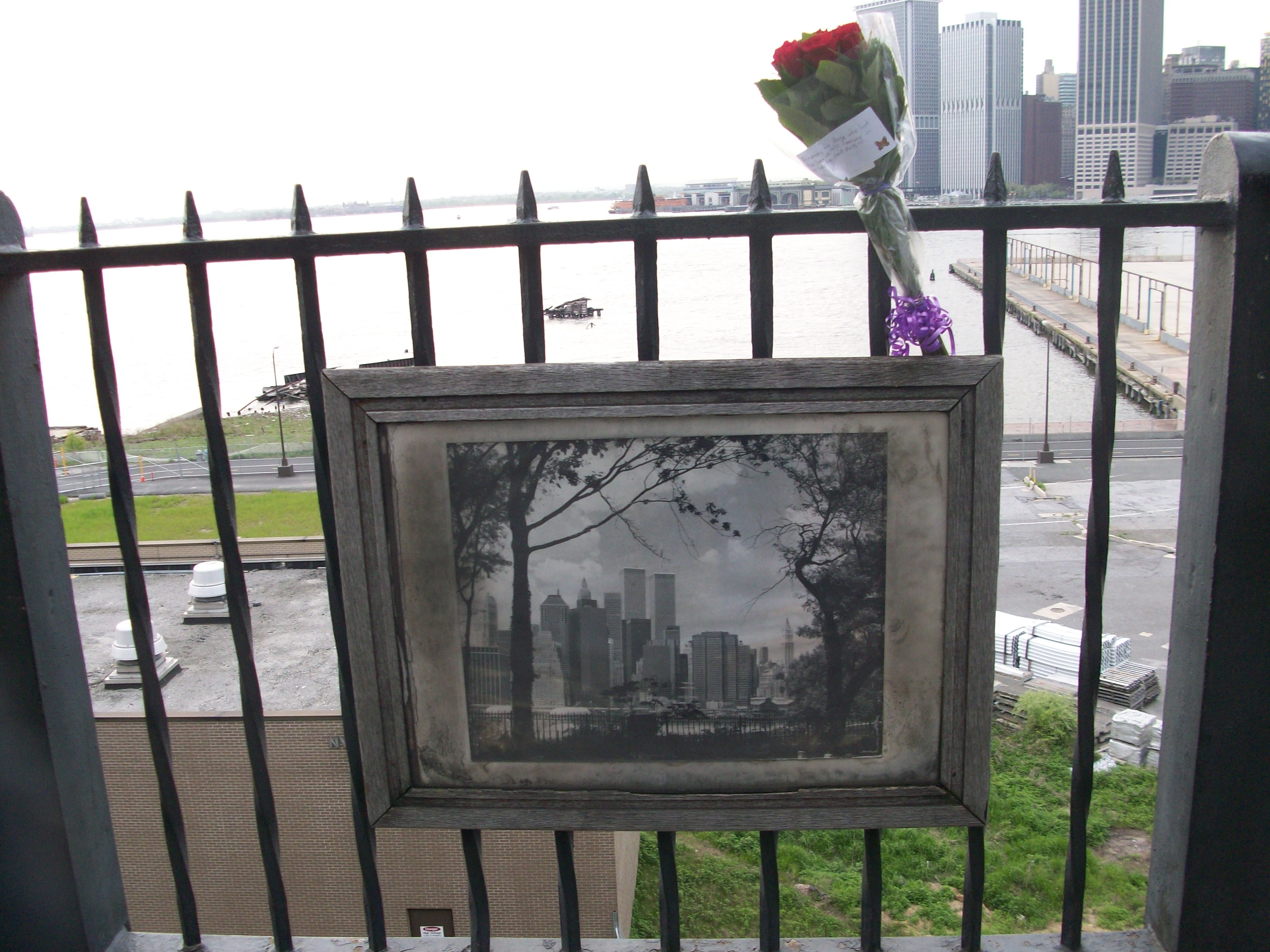
    As done before, some photos:

    Above that photo I had taken some years ago at the Brooklyn Promenade.
    I had also taken this photo a couple of years ago at the Brooklyn Promenade.
    I took this one on Sept. 10, 2012, via my old phone.
    Photo that I took on Sept. 10, 2012, via my old phone.

    See here for last year’s post, and here for the 2016 post, to access the links to earlier posts here on triscribe on this day.

    Take a moment to pause and reflect, and thanks for being here.

    (cross-posted at sswslitinmotion.tumblr.com)

  • More Thinking About Anthony Bourdain

    I recently watched an episode of “American Masters” on my local PBS
    station (WNET Channel 13)
    , regarding Jacques Pepin. I liked how the documentary made one have insight on Pepin as an immigrant who taught Americans how to think about food, and how to make and eat food. But, when Anthony Bourdain appeared as a talking head in the episode, I
    was struck by how I sad I felt, as I was watching this after Bourdain’s passing. Bourdain was so smooth about talking about Pepin and the art of food. Bourdain was not someone who didn’t know what he was talking about; he was very much a part of the food and television community.

    At least, CNN will be airing the last of Bourdain’s Parts Unknown. this fall. According to Time Out NY, in October, the Food Film Festival will premiere one of those final episodes, in which Bourdain checks out the Lower East Side of Manhattan.

    I’ve been meaning to share this for the longest time – this fascinating essay by Thomas Wickersham, manager of The Mysterious Bookshop, from June 14, 2018, on Bourdain as a mystery writer, over at Crime Reads. (h/t The Mysterious Bookshop’s Facebook page post). Perhaps I shouldn’t be surprised about that. As Wickersham noted, Bourdain’s style on his television shows, No Reservations and Parts Unknown, had a noir flair.
    It’s still hard to fully realize that we won’t have more after Bourdain’s final episodes.

    (cross-posted on sswslitinmotion.tumblr.com)

  • Happy Independence Day 2018!

    Happy Independence Day. It’s been a tumultuous year so far in politics and current events in America.

    (Current events being the first draft of history, as I’ve heard it been said, I think, by the late journalist Gwen Ifill).

    Take a moment to reflect on the meaning of “life, liberty, and the pursuit of happiness,” and don’t forget that the Constitution does say we’re “to form a more perfect union.”

    I mentioned this last 4th of July on Facebook, crediting the idea to WNYC’s Brian Lehrer: on America’s birthday, like any birthday, acknowledge it, warts and all, and hope (and work) for better.

    “I love America more than any other country in this world, and, exactly for this reason, I insist on the right to criticize her perpetually.” – James Baldwin. Something to think about in these times.

    See here for NPR’s traditional annual reading of the Declaration of Independence.

    Yes, there’s “Life, Liberty and the pursuit of Happiness,” but as I get older, I’m more struck by the end of the document, when the Founding Fathers state: “And for the support of this Declaration, with a firm reliance on the protection of divine Providence, we mutually pledge to each other our Lives, our Fortunes and our sacred Honor.”

    The Founding Fathers were about to do something dangerous, and they knew it. But, they went ahead together, in hopes of something good. Social contract theory meant something to them. The experiment continues, 242 years later.

    NPR on Facebook shared a link to a feature from July 4, 2010, wherein NPR’s Guy Raz interviewed author and historian Ray Raphael on dispelling myths about Independence Day and the revolution.  The linked page notes: “America ended up with the 4th because that’s the day the Declaration of Independence was sent out to the states to be read. The document was dated July 4, so that’s the day they celebrated.”

    As we lawyers say: just go by the effective date…

    I’m sharing this on triscribe, as around here, every day is APA Heritage, but  I had this link laying around since May: Atlanta Braves player Kurt Suzuki, on being an Asian American in Major League Baseball. Baseball has long been America’s game, but it is odd that there aren’t a lot of APAs in major league baseball, for any number of reasons.

    I’ve been terribly behind on blogging. We’ll see how the summer goes.

  • Some TV Highlights of 2017

    Here it is. As usual, my personal TV Highlights of 2017 is not really a best/worst list and, as noted in previous years, it doesn’t help that I’ve really cut back on tv viewing (shocking, I know; I’ve gotten behind on everything). I still don’t have Showtime or HBO (so no to the return of “Twin Peaks” – and I was rather sorry to not get to see the weirdness of the return of “Twin Peaks” – and no to “Game of Thrones” ).  And I have not pursued streaming tv  (so, still no to any of Marvel’s streaming stuff, or “The Handmaid’s Tale”). But, I managed to catch “Star Trek: Discovery” via a friend.  So maybe I’m not totally hopeless? Anyway, consider the following, which is in no particular order. Extra long post ahead!

    Elementary (CBS) / Sherlock (BBC/PBS) – Holmes and Watson, no matter their incarnation, continue to suck me in. CBS or the BBC/PBS versions remain perplexing (as in, what are you doing to these characters?), but watchable.

    Legion (FX) – Weird but incredible. Fun watch and the season finale left me wanting more (especially because the cliffhanger was super weird). Sublimely ridiculous, visually astounding. Dan Stevens, the ex-Matthew of Downton Abbey, was compelling as David and how David’s conflict with mental illness, romance, and reality can be – well – mindblowing.

    The Vietnam War by Ken Burns and Lynn Novick (PBS) – I still have to plow through all of it, but I was especially moved by the last episode.

    Star Trek: Discovery (All-Access CBS)

    I’m still taking the stand to not subscribe to All-Access CBS, and wound up watching ST: D with a friend, who did subscribe. Sonequa Martin-Green, who plays Michael Burnham, the alleged first Starfleet mutineer, has been a great actress to watch (I say “alleged” regarding Burnham’s status as the first mutineer because I still don’t believe that she could or should be the first – maybe she was the first one who was so baldly mutineering?).

    But, as NPR’s critic Eric Deggans noted in NPR’s 2017 favorite television year in review, the enigma of ST:D is Jason Isaacs’s Capt. Gabriel Lorca (Deggans observed, “But the real wild card is Jason Isaacs’s Gabriel Lorca, Starfleet’s most ruthless captain, whose actions constantly raise the question: If you give up your values to win a war, is the victory worth it?”).

    Really, Lorca is the weirdo Starfleet captain, in a show that was supposedly using a non-captain like Burnham to be the primary point of view character. Lorca’s fate is going to be curious; when you’re violating Starfleet’s ethics or going right at the edge of those standards of ethics, in the name of protecting the Federation, can you ever be redeemed or come back from the darkness? Hard to say, and it’s curious to ask if Lorca is the “good” captain (however we define it), as opposed to Captain Philippa Georgiou (played by Michelle Yeoh), who – by merit of her dialog and the sheer charisma of Yeoh, seemed to be the clearer good Starfleet captain.

    The Klingons haven’t interested me (I’ve yet to find the portrayal of Klingons to be that compelling, beyond the characters of Worf, Keylehr, Martok, and B’elanna Torres). And, I would really hate it if a certain Starfleet character turns out to be a Klingon in disguise. Well, we’ll see how the rest of this season of ST:D will go.

    Endeavour (PBS) – Under the Masterpiece Mystery umbrella, this series is what’s left of the universe of Inspector Morse, as the prequel to the Inspector Morse series and its spinoff, Inspector Lewis. This season, Endeavour continues – in a darker way – its exploration of Morse as a young man in 1960s England, solving crimes and pursuing a bitter path to becoming the inspector that he will one day become.

    Late Night TV – Late Night with Stephen Colbert (CBS) and The Daily Show with Trevor Noah (Comedy Central) are my main go-to’s for late night satire. I’d check in for John Oliver on YouTube/other outlets. Jimmy Kimmel on Jimmy Kimmel Live! (ABC) has had some key 2017 moments.

    The Oscars (ABC) – Jimmy Kimmel hosted the Oscars this year. That odd error of giving La La Land the Best Picture Award and then correcting it to give the award to Moonlight was the priceless live tv moment for me, as noted on this blog.

    Adventure Time (Cartoon Network) – Finn the Human and Jake the Dog are still on a journey.

    Duck Tales (Disney) – The series is back, but in a 21st century way. I watched maybe two episodes, the first one and something else. It was strange to hear actor David Tennant’s voice as Uncle Scrooge McDuck (the voice – while genuinely Scottish, didn’t quite have that gruff old man charm, and when I think of the old tv series voice actor, Alan Young, who did Scrooge McDuck for a real long time (I didn’t even realize that he was once Wilbur to Mr. Ed on tv).

    Doctor Who (BBC / BBC America) – There’s going to have to be a separate post to address how the Doctor had a very good season in 2017. NPR’s review, by Eric Deggans, of the Christmas episode has spoilers. There will be time enough for Jodie Whittaker as the 13th Doctor, the 1st woman as the Doctor (meanwhile, you can always watch her in that 1st season of “Broadchurch,” – in my mind, still the best season of that series, but that may be just me). But, I generally agreed that we can appreciate this final moment of actor Peter Capaldi as the 12th Doctor. Capaldi earned it, with his acting out the trajectory of the 12th Doctor and making the viewer feel, not just watch, the 12th Doctor’s journey. He made us appreciate what kindness really means. Thanks, Capaldi. Looking forward to seeing what you’ll do next!

    The era of “#me too” involved seeing all kinds of people get their comeuppance for sexual harassment/sexual assault, and at the substantive level, we’ll see how this may be a cultural shift. But, considering how it affects television, this has created a different television landscape – at least, no Mark Halperin, no Charlie Rose, no Matt Lauer, and even no Tavis Smiley. At the very superficial level, this has felt really strange to me, since I used to watch a lot of Charlie Ross, and well, so that goes.

    Seeing Washington Week (PBS) without Gwen Ifill on the series also made for an odd 2017 in tv for me. Her passing away left such a gap; I kept wondering what she would have thought or said about the craziness that was 2017.

    Saturday Night Live (NBC) was uneven as ever in 2017 (this is a perennial complaint or issue with SNL), but the segments of Weekend Update have been fun for seeing whether Colin Jost and Michael Che would hit the ball out of the park with their lines and zingers.

    The Great British Baking Show (BBC / PBS) – The show will have changes (or already has, since its latest season already aired in Britain), since it left BBC. But, what looked like its last BBC season aired on PBS, and it was entertaining and relaxing to me.

    Dancing with the Stars (ABC) – The show is just fun. I’m not looking for much when I watch it. I will also never understand the show’s music selection for some dances, but I suppose that’s part of its charm? Oh well.

    Honorable mentions: Victoria (under the Masterpiece umbrella on PBS); Blackish (ABC); Fresh off the Boat (ABC); and We Bare Bears (Cartoon Network).

  • Memorial Day 2017

    On Memorial Day: be sure to take a moment to reflect on those who served and made the ultimate sacrifice for us and our values.

    And, to those who observe: best wishes for Ramadan.

    I think that Memorial Day and APA Heritage Month make for an interesting combination.  It’s more than enjoying the unofficial start of summer, but to reflect and consider people who don’t always get remembered.

    Consider: NBC News Asian America has an interesting article by Lakshmi Gandhi, profiling Hazel Ying Lee, “Remembering Hazel Lee , the first Chinese-American Female Military Pilot.” She was one of two Asian-American women who were WASPs, when WASPs weren’t necessarily considered part of the military, and when civilians wondered if Chinese people were the Japanese enemy.

    Or consider this NPR item, which aired on “All Things Considered”: “Don’t Say ‘Thank You for Your Service’ This Monday,” as we recognize that those who served are part of the diverse fabric of American life – and they do what they believe in, not to be thanked, and because we should remember their friends who didn’t get to come home.

    I also tend to think that Americans have lost sight of the meaning of both Memorial Day and Veterans Day (aka Armistice Day, aka the day that World War I ended). While you should enjoy the day, it’s not as simple as saying “Have a Happy One,” when there ought to be more reflection or service involved.

    (and as for how we treat those who served, served, and survived – well, that’s another issue, but it’d be nice if we can do better for them; like the article says, saying thanks is nice, but it’s not an end in and of itself).

    And, bearing in mind that Memorial Day was once Decoration Day, it’s also about tending to the tombs and paying respect.  I liked this item over at NPR, about a man’s project to clean the headstones of World War I veterans.

    “Perhaps not imagining a face of an individual is a product of the military culture, one that simply relied on trusting the members of your team, regardless of where they came for or what they looked like. And perhaps seeing the green, blue, white, tan, or khaki uniform is all I really needed to know because people of all races, creeds, color, and religions have fought for our country.” — Art delaCruz.

    delaCruz’s moving essay over at NBC News Asian America is worth a read. In our current charged political climate (then again, when is it not charged?), perhaps it’s more important than ever to reflect on the diversity and commonality of our armed forces and how that represents all of us.  A lot of food for thought.

  • APA Stuff to Consider, or Spring 2017 Begins

    There is still snow on the ground, even though it is melting.

    Worthwhile items about Chinese Americans over at NPR, from last week: gentrification of Chinatowns.  When an immigrant community’s next generation assimilates or moves on, or there are changes in the types of jobs available, a community will change. But, gentrification in terms of race and class – that’s not exactly comfortable stuff.

    The story of the Delta Chinese, as fascinatingly portrayed on NPR, is sort of a contrast to the gentrification of Chinatown. It isn’t quite about displacement by class and race, but the evolution of immigration and society is something to remember and reflect on. (btw – definitely worth reading this NPR item, along with the other NPR item on gentrification of Chinatowns).

    The NPR item on gentrification of Chinatowns, notably, quoted Peter Kwong, Hunter College professor, and Asian American studies pioneer, who observed that New York City’s Chinatowns may be the last stand of a working class, viable Chinatown.  Sadly, Kwong passed away last Friday, as announced in the news.  (h/t Asian American Writers’ Workshop‘s Facebook page post).  Things to think about, as we consider the history of Chinese in America, and how do we go forward.